What Is DTF Printing? How It Works, What It Costs, and What It's Best For
If you sell print-on-demand products, DTF is the acronym you keep running into: on a supplier's product page, in a fulfillment quote, in a forum thread about which method lasts longest. It usually turns up without much explanation, which leaves you guessing what it actually means for the shirt, hoodie, or tote your customer opens. The short answer is that DTF stands for direct-to-film, a method that prints your design onto a special film and then heat-presses it onto the garment. The longer answer, how it works, what it costs, how durable it is, and where it beats or loses to DTG, is what this guide covers, from the perspective of a company that runs these presses every day.
The short version
- DTF means direct-to-film: your design is printed onto a film, coated with adhesive powder, cured, and heat-pressed onto the fabric, so the print bonds to almost any surface rather than only cotton.
- Its superpower is versatility. Cotton, polyester, blends, nylon, canvas, tote bags, and caps all print well, which is why one method can cover most of a mixed catalog.
- It excels on dark and coloured garments: bright, opaque prints, no pretreatment step, and genuinely white whites.
- It is very durable. A properly cured DTF print typically survives 50 or more washes and resists cracking because the film flexes with the fabric.
- The trade-off is feel. You can feel a thin, smooth layer sitting on the surface, so it is not as invisible as DTG on soft cotton.
| DTF at a glance | |
|---|---|
| What it is | Ink printed onto film, powdered with adhesive, cured, then heat-pressed onto the garment |
| Best fabric | Almost anything: cotton, polyester, blends, nylon, canvas |
| Dark garments | Excellent, with no pretreatment needed |
| Colour and detail | Vibrant, opaque colour; very good detail, slightly softer than DTG on hairlines |
| Feel | A thin, smooth layer you can feel on the surface |
| Durability | Excellent: 50+ washes, resists cracking and peeling |
| Setup cost | None. No screens, no minimums |
| Makes sense from | 1 piece |
| Weak spots | Large solid prints feel heavier; not as soft as DTG on cotton |
What is DTF printing?
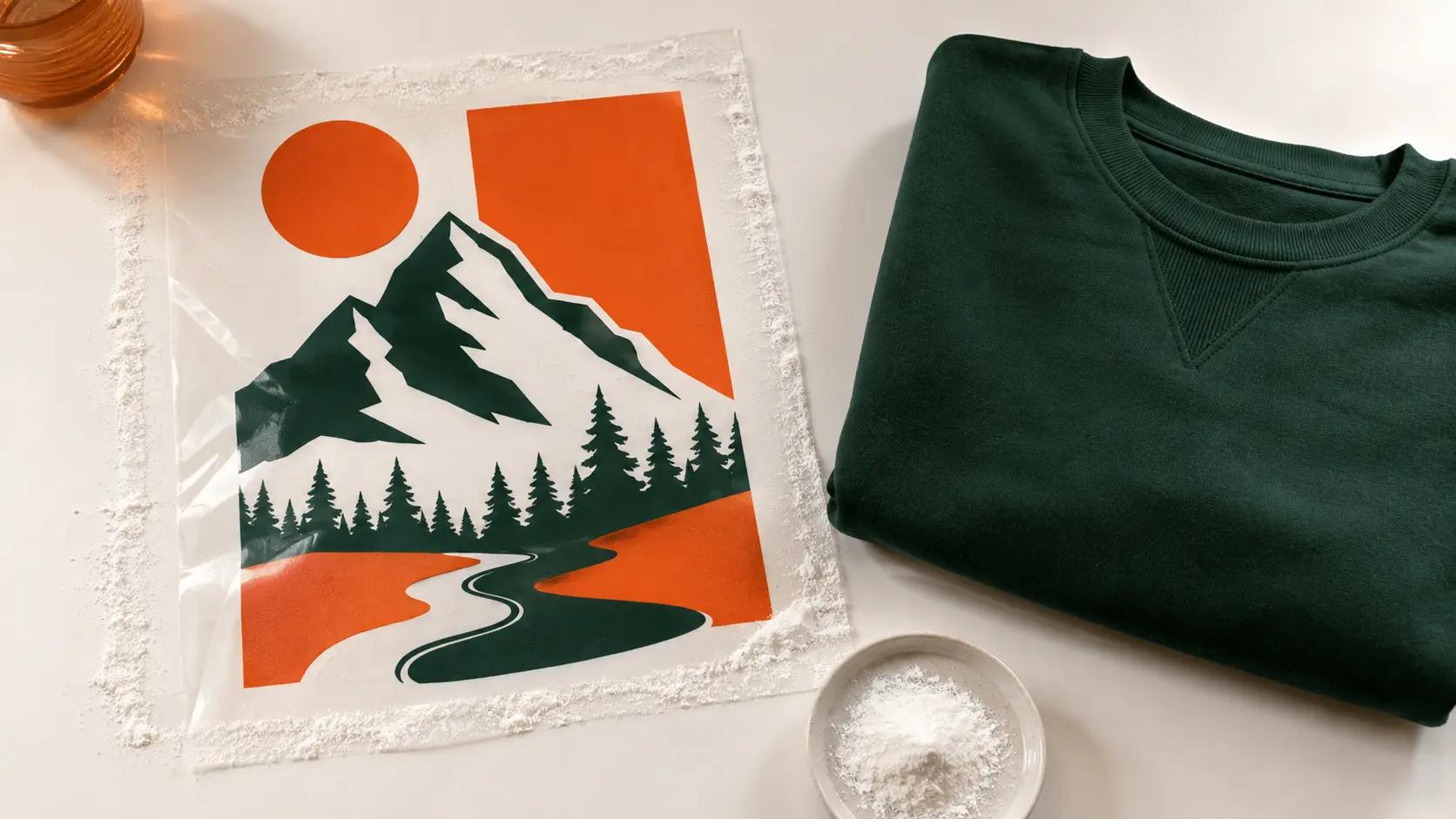
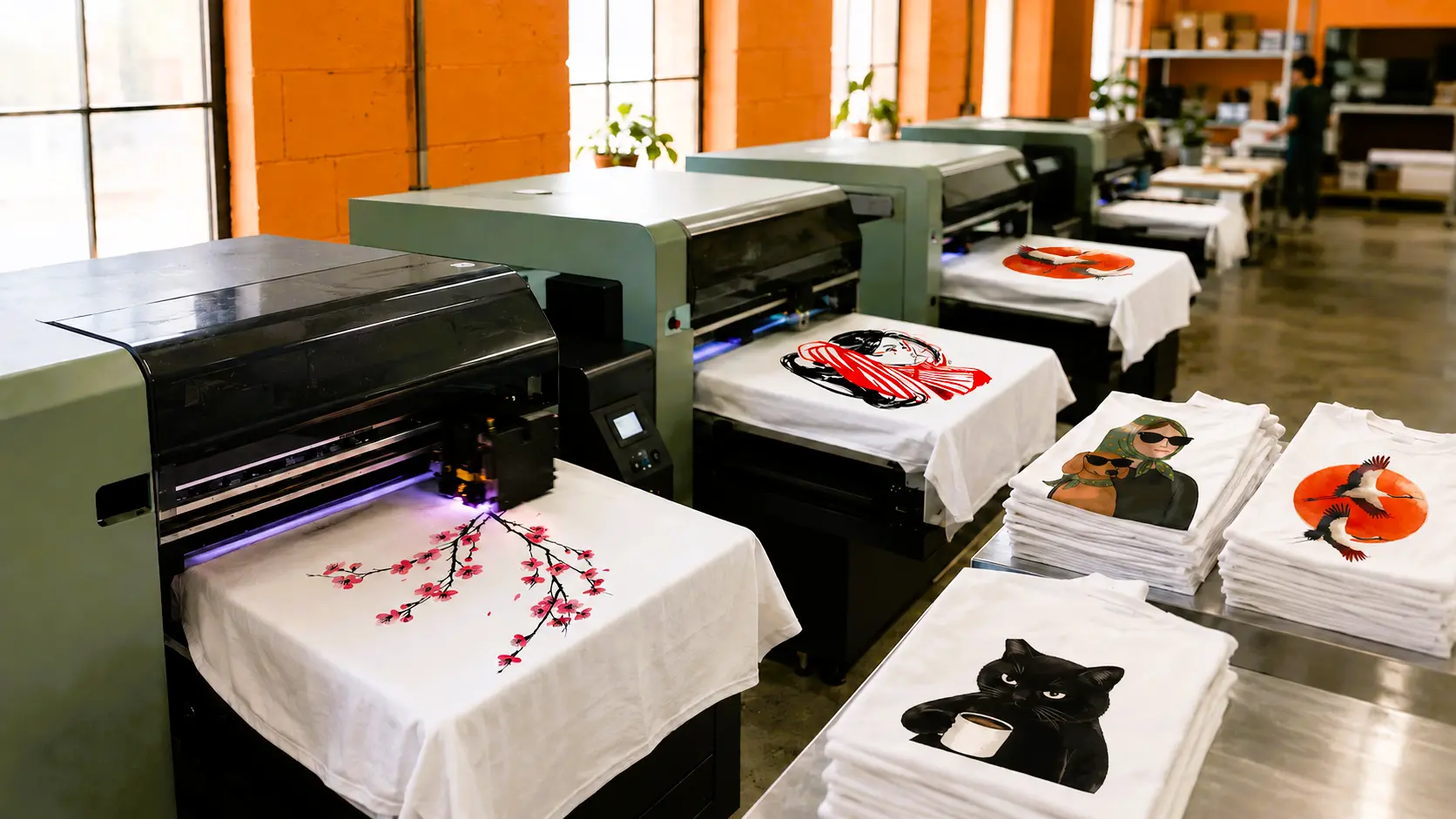
DTF printing, short for direct-to-film, is a transfer method. Instead of printing your design straight onto the garment the way DTG does, a printer lays the design down on a sheet of PET film using specialised water-based inks, including a white layer. While the ink is still wet, a fine adhesive powder is applied, then the film is cured with heat so the powder melts into a glue. The finished transfer can then be heat-pressed onto almost any fabric, where the design bonds to the surface as a thin, flexible layer.
That one structural difference, printing onto film first rather than into the fabric, is what gives DTF its defining trait: it does not care much what the garment is made of. Because the design carries its own adhesive, it bonds to polyester as happily as cotton, and to a nylon bag as happily as a t-shirt. It is the closest thing print on demand has to a universal method.
DTF is also the newest of the mainstream methods, which is part of why you are seeing it everywhere at once. It arrived to solve the biggest limitation of DTG, which is that DTG really only works well on cotton, and it spread quickly because it let fulfillers print a much wider catalog on a single machine.
How does DTF printing work?
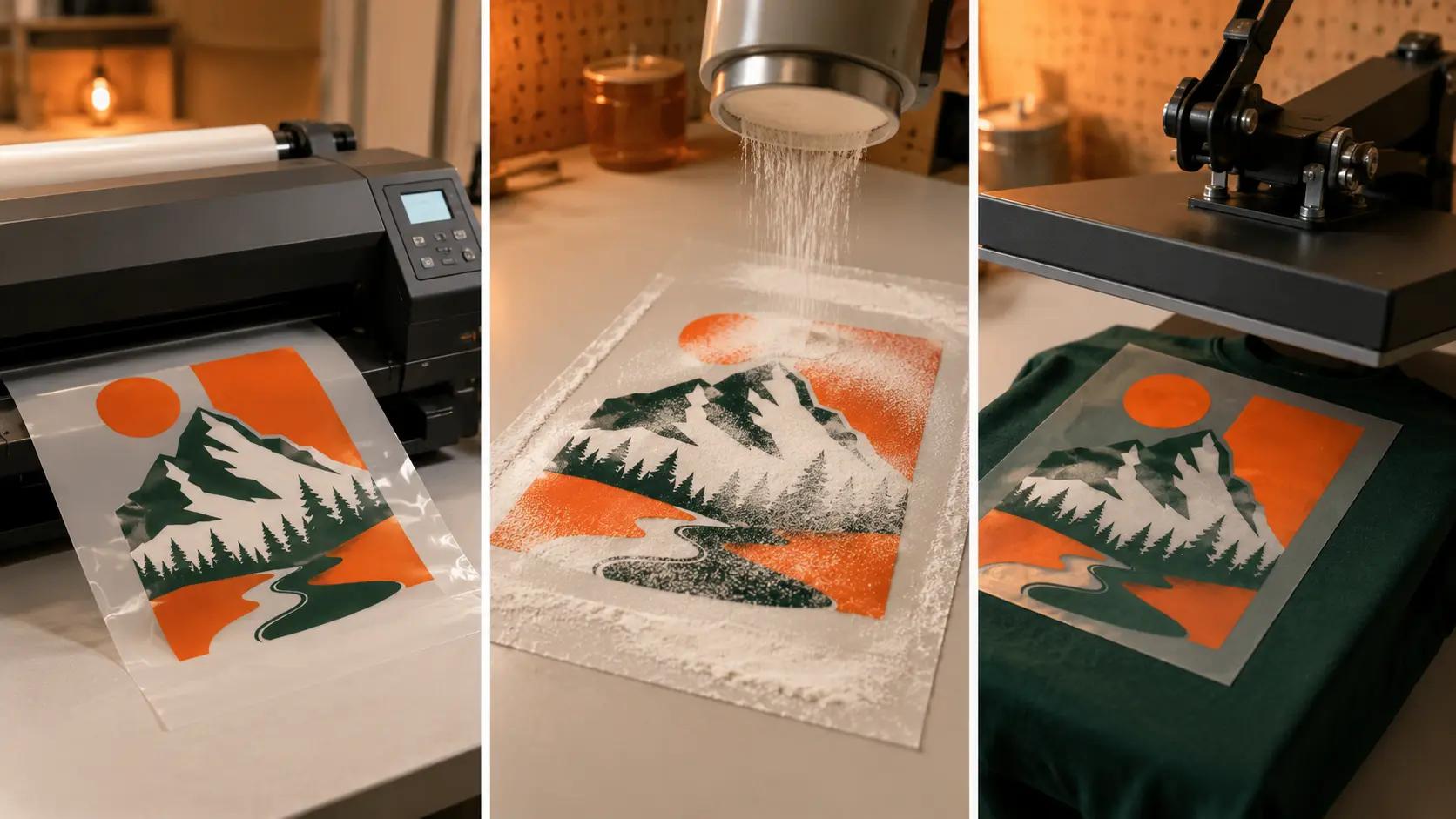
From file to finished garment, a DTF print moves through four stages. You will never touch the machine yourself, but knowing the steps tells you where quality is won or lost.
1. Printing the film. The design is printed onto PET film, laying down colour first and then a white backing layer on top. That white layer is what makes DTF so strong on dark garments, because the colours end up sitting on white rather than on the shirt.
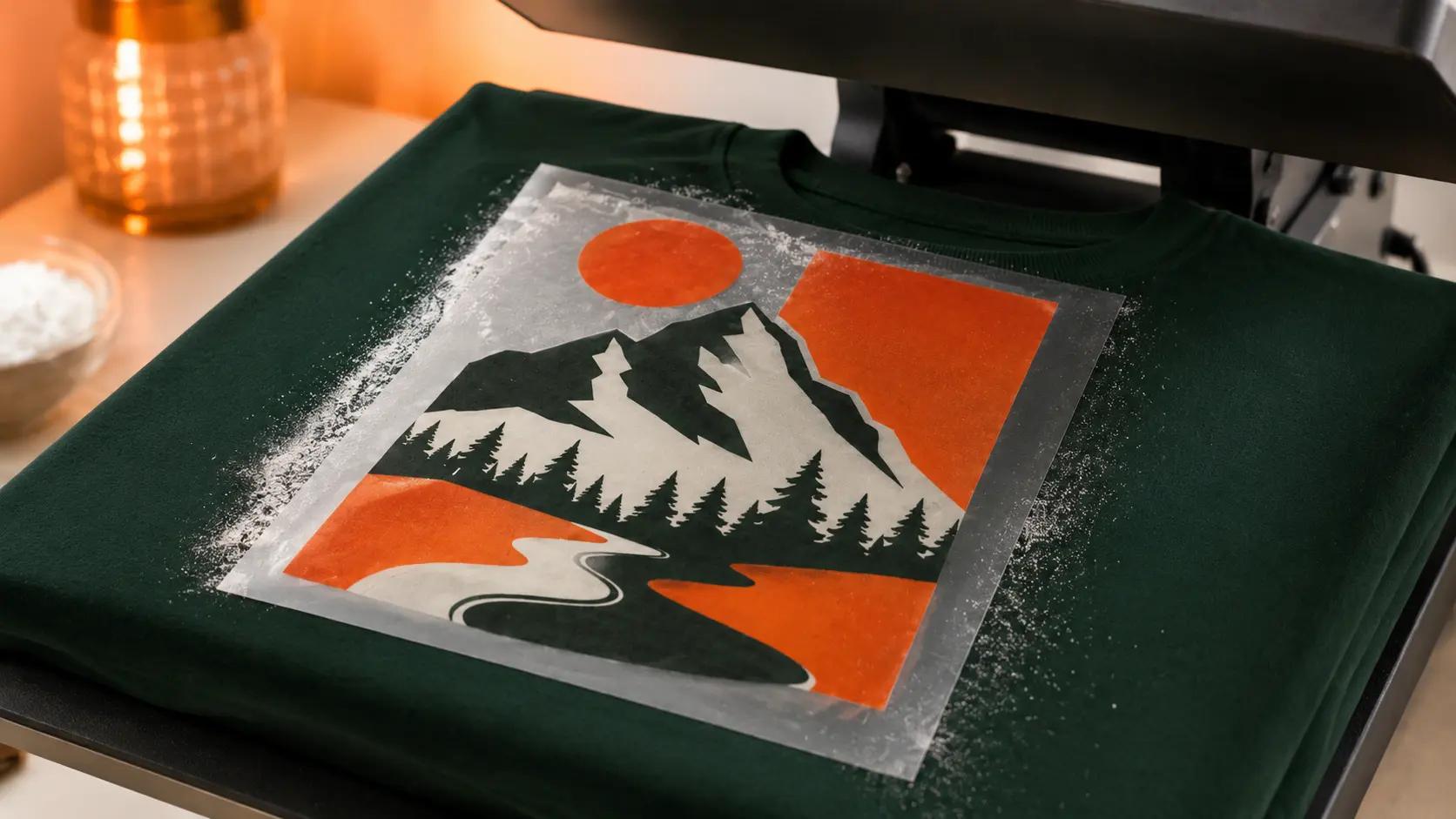
2. Applying the powder. While the ink is still wet, a hot-melt adhesive powder is dusted across the printed area and the excess is shaken off. This powder is the glue that will eventually bond the design to the fabric.
3. Curing. The powdered film is heated until the adhesive melts and fuses to the ink, creating a finished transfer that can be pressed immediately or stored for later.
4. Pressing. The transfer is positioned on the garment and heat-pressed at roughly 300 to 320°F for about 15 seconds, then the film is peeled away, leaving the design bonded to the fabric. Whether the film peels hot or cold depends on the specific film, and getting that step right is one of the small details that separates a durable print from one that lifts at the edges.
What does DTF printing cost?
For a seller, the number that matters is the one on your fulfillment invoice, but it helps to know what sits behind it. In materials alone, ink, film, and powder, a typical DTF transfer costs somewhere around $0.50 to $2.00 depending on the size of the design, with large, ink-heavy prints at the top of that range. There is no white-ink-on-dark penalty the way there is with DTG, because DTF always lays down a white layer regardless of garment colour.
Through a print-on-demand partner, all of that is rolled into one flat price per piece, and for a printed tee you are usually looking at something in the same $9 to $16 range as DTG, depending on the blank and the print size. There are no setup fees and no minimums, which is the whole appeal of print on demand: your first sale is profitable on its own and you never hold inventory. If pricing is the stage you are wrestling with, our guide on pricing POD products for real margin goes deeper than we can here.
Is DTF printing good quality, and how long does it last?
Yes, with the same two conditions that govern every print method: the transfer has to be applied and cured correctly, and the garment has to be a sensible match. When both are true, DTF is one of the most durable prints you can buy. A properly pressed transfer routinely survives 50 or more washes with very little fading, and because the film flexes with the fabric, it resists the cracking that plagues cheaper transfer methods.
Because you would rather hear the failure modes from a printer than from a one-star review, here is where DTF goes wrong and why:
- Peeling at the edges. Almost always an application problem: not enough heat, pressure, or time at the press, or the wrong peel, hot versus cold, for the film. A well-pressed transfer does not lift.
- A stiff, heavy patch. On a large solid print, DTF lays down a continuous layer you can feel. It is much lighter and more flexible than old vinyl or heavy plastisol, but it is not the barely-there hand of DTG. Breaking a big design into finer elements reduces this.
- Slightly soft edges on hairline detail. DTF resolves fine text and thin lines well, but DTG still has a small edge on the very finest detail. For most designs you will not notice.
- A faint film outline, rarely. On very light garments the edge of the transfer can occasionally catch the light. Good trimming and a matte film make this a non-issue.
Compared with DTG, DTF generally wins on durability and loses on feel. For most catalogs that is a fair trade, and it is the reason so many shops settle on DTF as their everyday method.
What garments and products does DTF work on?
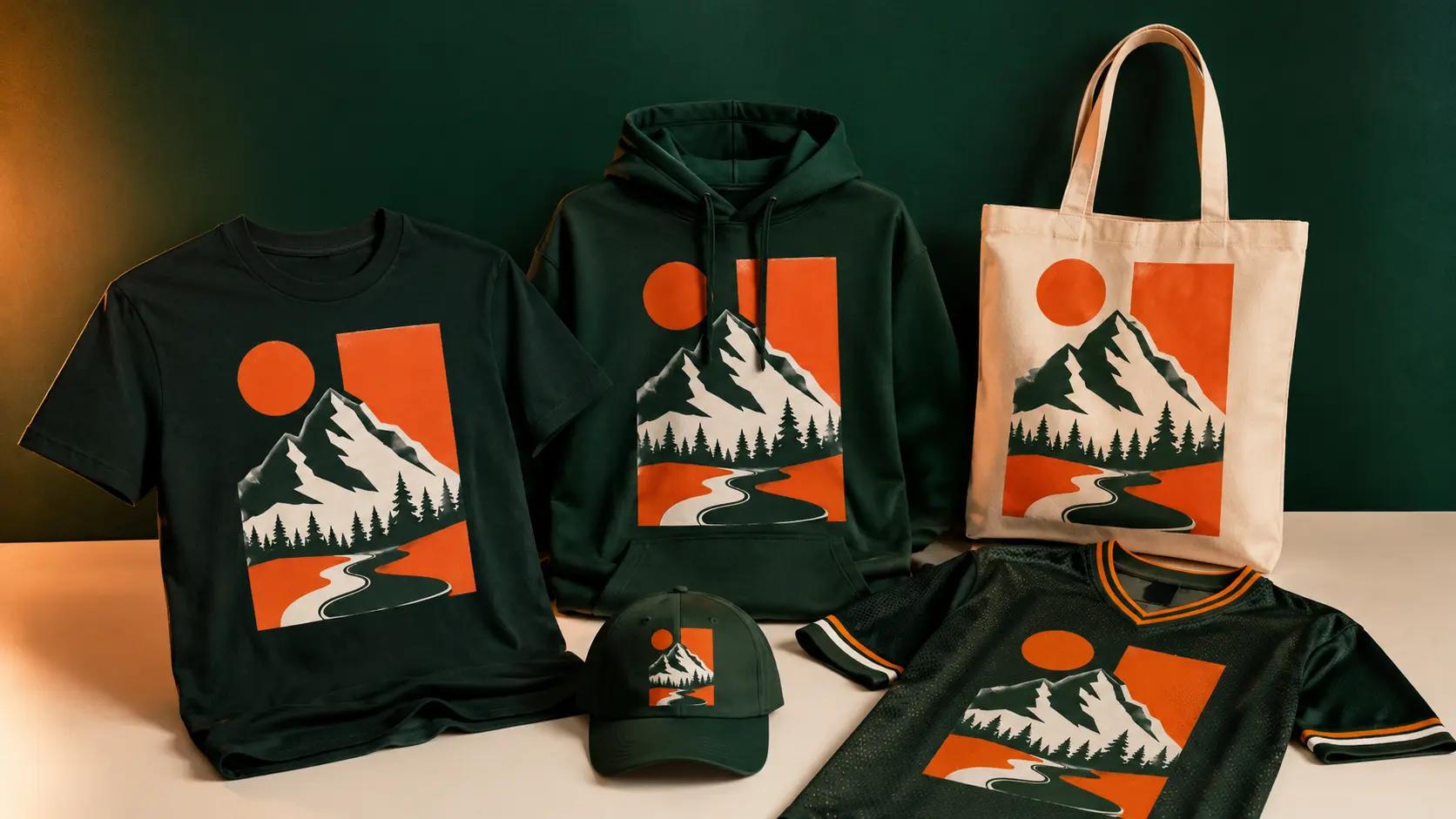
This is where DTF earns its reputation. Because the design bonds to the surface rather than soaking into natural fibres, it works on nearly anything:
- Cotton, polyester, and every blend in between, including the performance and athletic fabrics DTG cannot touch.
- Dark and brightly coloured garments, with no pretreatment and genuinely opaque colour.
- Non-apparel items like tote bags, aprons, and canvas, anywhere you can get a heat press onto a flat area.
- Caps and hard-to-reach areas, using specialised presses that DTG's flat platen cannot handle.
The main things to avoid are heat-sensitive materials that can scorch, and extremely stretchy technical fabrics where even a flexible film can eventually crack. For a straight cotton tee where you want the softest possible hand, DTG is still the better pick, which is exactly the kind of trade-off we walk through in our full DTG vs DTF vs screen printing comparison and in our explainer on DTG itself.
When should you use DTF, and when should you not?
Reach for DTF when:
- The garment is not pure cotton: polyester, blends, nylon, or performance wear.
- You are printing on dark or coloured garments and want the colour to pop.
- Your design has bold blocks of colour, or you simply want the most wash-resistant option.
- You are running a mixed catalog and want one method that covers most of it.
Look elsewhere when:
- You want the softest possible hand on a 100% cotton tee. That is DTG.
- You are running one simple design in real volume, roughly 50 pieces or more. Screen printing wins on unit cost.
- You need true neon or metallic colour, or all-over prints on polyester. That is screen printing and sublimation respectively.
For most sellers the honest answer is a split: DTG for soft cotton tees, DTF for everything else. If you are staring at a specific product and cannot tell which way to go, that is a two-minute question worth asking your fulfillment partner before you commit a whole run to it.
Frequently asked questions
What does DTF stand for?
Direct-to-film. The name describes the process: the design is printed onto a film first, then transferred onto the garment with a heat press, as opposed to DTG, direct-to-garment, which prints straight onto the fabric.
Does DTF printing crack or peel?
A properly cured and pressed DTF print resists both, because the film flexes with the fabric rather than sitting rigid on top. When DTF does peel, it is nearly always an application error, too little heat, pressure, or time, which a reputable provider will reprint. Washing cold and skipping the dryer extends any print's life.
Is DTF better than DTG?
Neither is better; they are built for different jobs. DTF wins on versatility and durability, especially on polyester, blends, and dark garments. DTG wins on feel, giving the softest possible hand on cotton. Most catalogs use both.
Does DTF work on polyester?
Yes, and this is one of its biggest advantages. Unlike DTG, which needs natural fibres to bond to, DTF prints cleanly on polyester and performance fabrics, which is why it is the go-to for activewear and jerseys.
How long does a DTF print last?
A well-made DTF print typically lasts 50 or more washes with minimal fading or cracking, often outlasting a comparable DTG print. Longevity depends far more on how well it was pressed than on the design itself.
Is DTF good for small print-on-demand orders?
Very. There are no screens to make and no minimums, so a single unit costs the same to print as the fiftieth. That is what makes it a natural fit for print on demand, where every item is made after it sells.
The bottom line
DTF is the method that made print on demand truly catalog-wide: one process that handles cotton, polyester, blends, darks, and bags, with a durable, colourful print and no setup cost. Keep the pressing right and match it to the garment, and it will quietly hold up wash after wash. If you are weighing DTF against DTG for a specific product, or you would just like a second opinion before you list it, talk to us before you commit to a run. We print all of these every day, and we would rather point you to the right method up front than reprint it after.
Related guides
Switch to Pengine.
We offer a fully managed migration service at no extra cost, including product transfer and setup support.