DTG vs DTF vs Screen Printing: How to Pick the Right Method for Each Product
DTG is usually best for detailed, full-color designs on cotton; DTF works across polyester, blends, and dark garments; and screen printing is generally the strongest value for larger runs of the same design. The right choice depends on fabric, garment color, artwork, order quantity, durability, and how you want the finished print to feel.
For most print-on-demand products you are really choosing between four options: DTG, DTF, screen printing, and sublimation. Each one has fabrics and order sizes it handles well, and a few it struggles with. Here is a straightforward look at how they compare, and how we would match them to what you are actually selling.
DTG vs DTF vs Screen Printing: Quick Comparison
If you only take away a few rules of thumb, make it these:
- Printing on 100% cotton and want the softest possible feel? Go with DTG.
- Printing on polyester, blends, or dark garments, or you just want the most durable everyday print? DTF is usually the safer bet.
- Running the same design in real quantity, somewhere north of 50 pieces? Screen printing starts to win on both cost and longevity.
- Making all-over prints, or printing polyester items like performance wear and mugs? That is sublimation territory.
- Selling a mixed catalog? Most shops settle on DTG for cotton and DTF for everything else, and only reach for the others when a specific product calls for it.
| DTG | DTF | Screen printing | Sublimation | |
|---|---|---|---|---|
| Best fabric | 100% cotton | Almost anything | Cotton and blends | Polyester only |
| Dark garments | Yes, with pretreatment | Yes, and it excels here | Yes | No |
| Fine detail and photos | Excellent | Very good | Limited | Excellent |
| Feel on the shirt | Softest, sits in the fabric | Thin layer you can feel | Heavier with plastisol | None at all |
| Durability | Good, softens over time | Excellent | Excellent | Permanent |
| Setup cost | None | None | Per color, per design | None |
| Makes sense from | 1 piece | 1 piece | ~25 to 50+ pieces | 1 piece |
| Typical use | Cotton tees, detailed art | Hoodies, blends, dark colors | Big single-design runs | All-over prints, mugs, poly |
The single most useful habit is to start with the garment, not the graphic. Once you know the fabric and the color, the method almost picks itself.
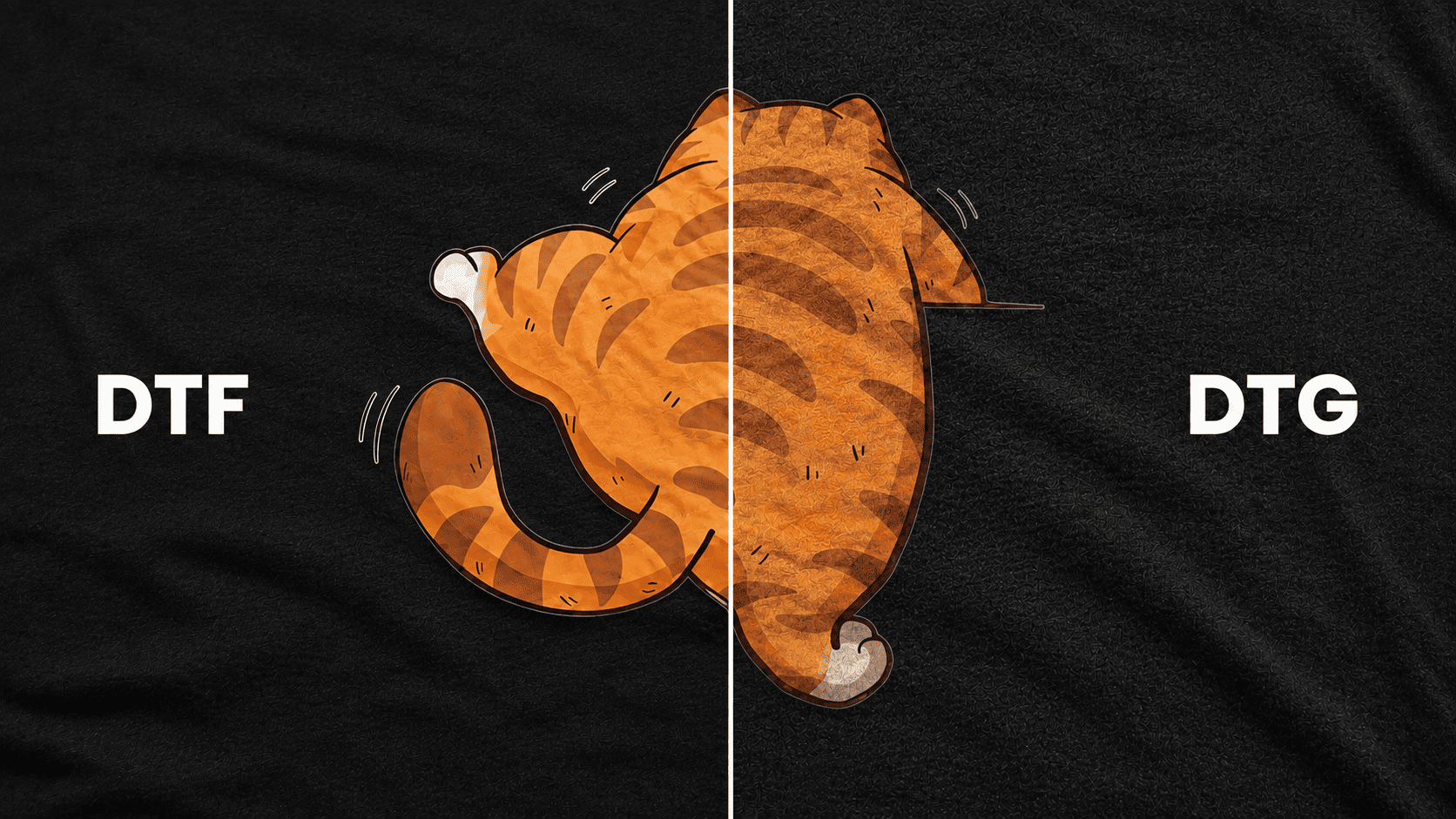
DTG: soft prints that sink into the cotton
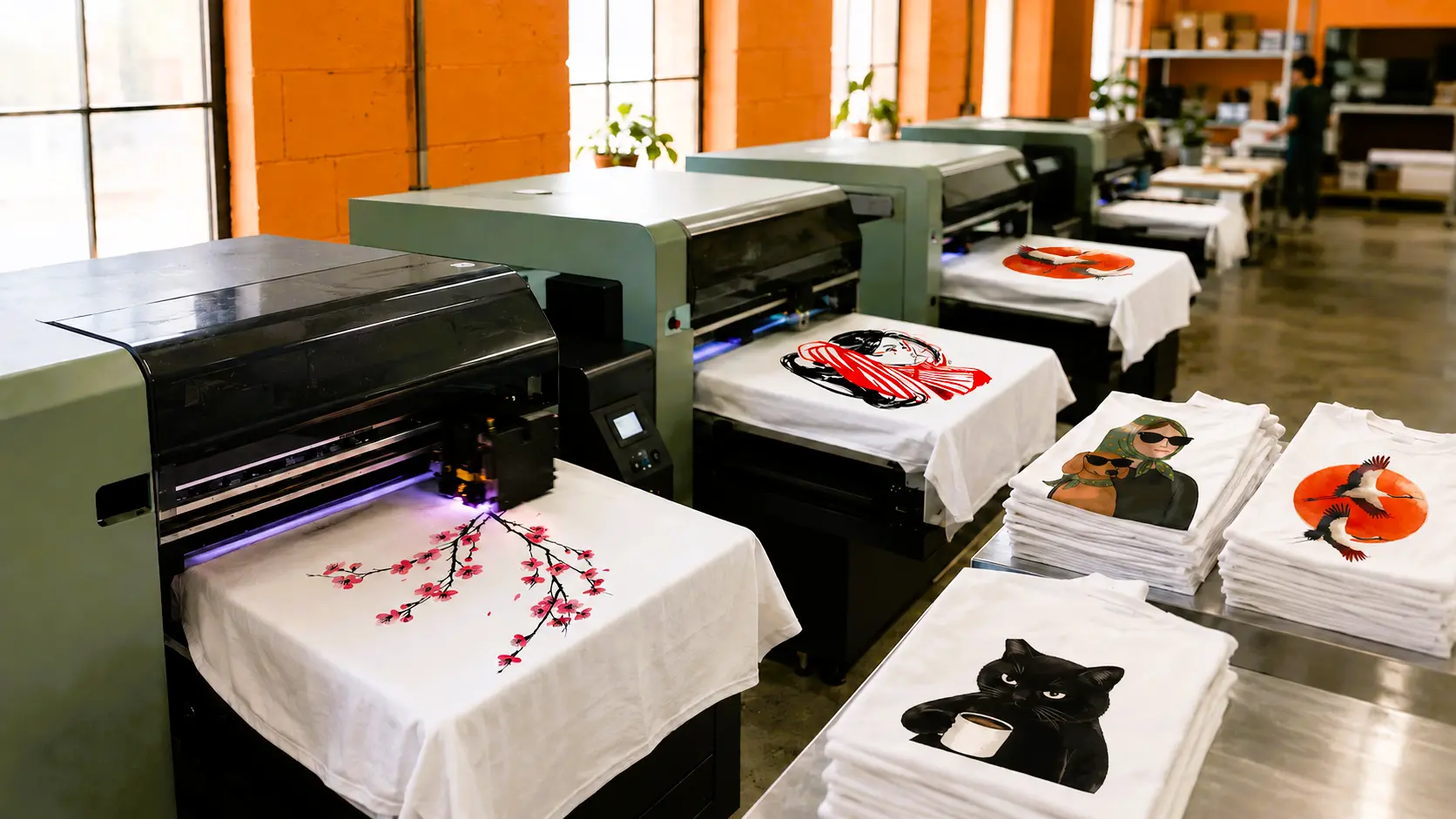
Direct-to-garment printing works a lot like a very good inkjet printer, except it prints onto a shirt instead of paper. Water-based ink is laid directly onto the garment and soaks into the fibers, which is the key to how it feels. Because the ink becomes part of the fabric rather than sitting on top of it, a good DTG print has almost no hand to it. Run your fingers across the design and you can barely tell where it starts. For a soft, broken-in cotton tee, nothing else feels quite as natural.
It is also the method to reach for when the artwork is complicated. Photographs, gradients, watercolor effects, designs with dozens of colors in them, DTG handles all of it without any extra setup, because there are no screens to make and no per-color charges.
The catch is that DTG really wants cotton. The ink bonds to natural fibers, so on polyester it has far less to hold onto and the results look muted and wear faster. Blends land somewhere in the middle: a 90/10 usually prints well, while a 50/50 comes out noticeably softer and lighter than you might expect.
Dark shirts add one more wrinkle. They need a pretreatment, a liquid base that gets sprayed on and pressed before printing so the white ink has something to sit on. Done properly it is invisible. Done poorly, you get a faint square around the design, which is far and away the most common DTG complaint we hear. If you are ordering a sample on a dark garment, that is the first thing to check.
As for longevity, a well-made DTG print on ring-spun cotton will typically look good for dozens of washes before it starts to fade, and it tends to soften gradually rather than crack. Most customers read that as a shirt aging nicely rather than a print failing.
Reach for DTG when you are printing on cotton, the design has fine detail or lots of colors, and you want the lightest, softest finish possible.
DTF: a flexible print that goes on almost anything
Direct-to-film is the newer arrival, and it solved the biggest problem DTG has. Instead of printing onto the garment, the design is printed onto a sheet of film, coated with a fine adhesive powder, cured, and then heat-pressed onto the fabric. What you end up with is a thin, flexible layer of ink bonded to the surface.
Because it does not rely on soaking into the fibers, DTF works on nearly everything: cotton, polyester, blends, nylon, canvas, even the odd tote bag or cap. That versatility is why it has spread so quickly. One method covers a catalog that would otherwise need two or three.
It is especially strong on dark garments. There is no pretreatment step, the whites come out genuinely white instead of a little gray, and the colors tend to pop harder than DTG on the same black shirt. Durability is the other selling point. A properly cured DTF print will usually outlast a comparable DTG one, and it resists cracking well because the film flexes along with the fabric.
The trade-off is that you can feel it. On a large front print there is a smooth patch sitting on top of the shirt. It is much lighter and more flexible than an old-school vinyl or heavy plastisol print, but it is not invisible the way DTG is. Very fine detail can also lose a touch of crispness at the edges, so for hairline text or delicate line work, DTG still has a slight edge.
Reach for DTF when the garment is not pure cotton, you are printing on dark colors, the design has bold blocks of color, or you simply want the most wash-resistant option.
Screen printing: the workhorse for volume
Screen printing is the oldest method here and still the best at what it does. Ink is pushed through a fine mesh stencil onto the garment, with one screen made for each color in the design. Those screens are where the economics come from. Making them takes time and money before a single shirt is printed, so a two-color design carries setup charges before you even start. Print one shirt and that cost stings. Print five hundred and it disappears into the run.
The break-even point usually sits somewhere around 25 to 50 pieces of the same design, depending on the color count. Below that, DTG or DTF will almost always be cheaper. Above it, screen printing pulls ahead and keeps pulling ahead as the numbers climb.
What you get for the setup is the most durable and most vibrant print available. Plastisol ink sits thick and opaque, and a well-cured screen print will often outlast the shirt itself. It also unlocks effects the digital methods cannot touch, like puff ink that rises off the fabric, metallics, and discharge printing that dyes the fabric itself and leaves no hand at all.
Where it falls down is detail. Photographs and smooth gradients need halftones and a lot of skill, and even then the result rarely matches what DTG does effortlessly. Designs with more than a handful of colors get impractical fast. And fundamentally it is the wrong shape for print on demand, which is built around making one item at a time with no inventory.
Reach for screen printing when a single design is selling steadily in volume, the artwork is simple and bold, or you want a specialty finish like puff or metallic.
Sublimation: dye that becomes part of the fabric
Sublimation is the odd one out. Solid dye is heated until it turns straight into a gas, which then bonds inside polyester fibers and solidifies there. The design does not sit on the fabric so much as become it.
That gives it two qualities nothing else can match. There is zero hand, since there is no ink layer at all, and the print cannot crack, peel, or fade in any normal sense because there is nothing on the surface to fail. It also makes true all-over printing possible, with designs that run across seams right to the edge of the garment.
The limits, though, are strict. Sublimation only works on polyester or poly-coated surfaces, so cotton is off the table entirely. And it only works on white or very light items, because the dye is translucent and there is no white ink in the process. Any part of a design that relies on white will simply show the garment color underneath.
Reach for sublimation when you are doing all-over prints, polyester performance wear, or hard goods like mugs and phone cases.
What about embroidery?
It is a different animal, but worth a mention because it competes for the same budget. Embroidery stitches thread into the garment instead of printing on it, and it reads as more premium on hats, polos, jackets, and workwear. It carries a one-time digitizing fee to turn your artwork into a stitch file, it cannot reproduce photographic detail, and it works best on simple logos and text. For a brand where a polished, understated look matters more than intricate art, it is often the right call.
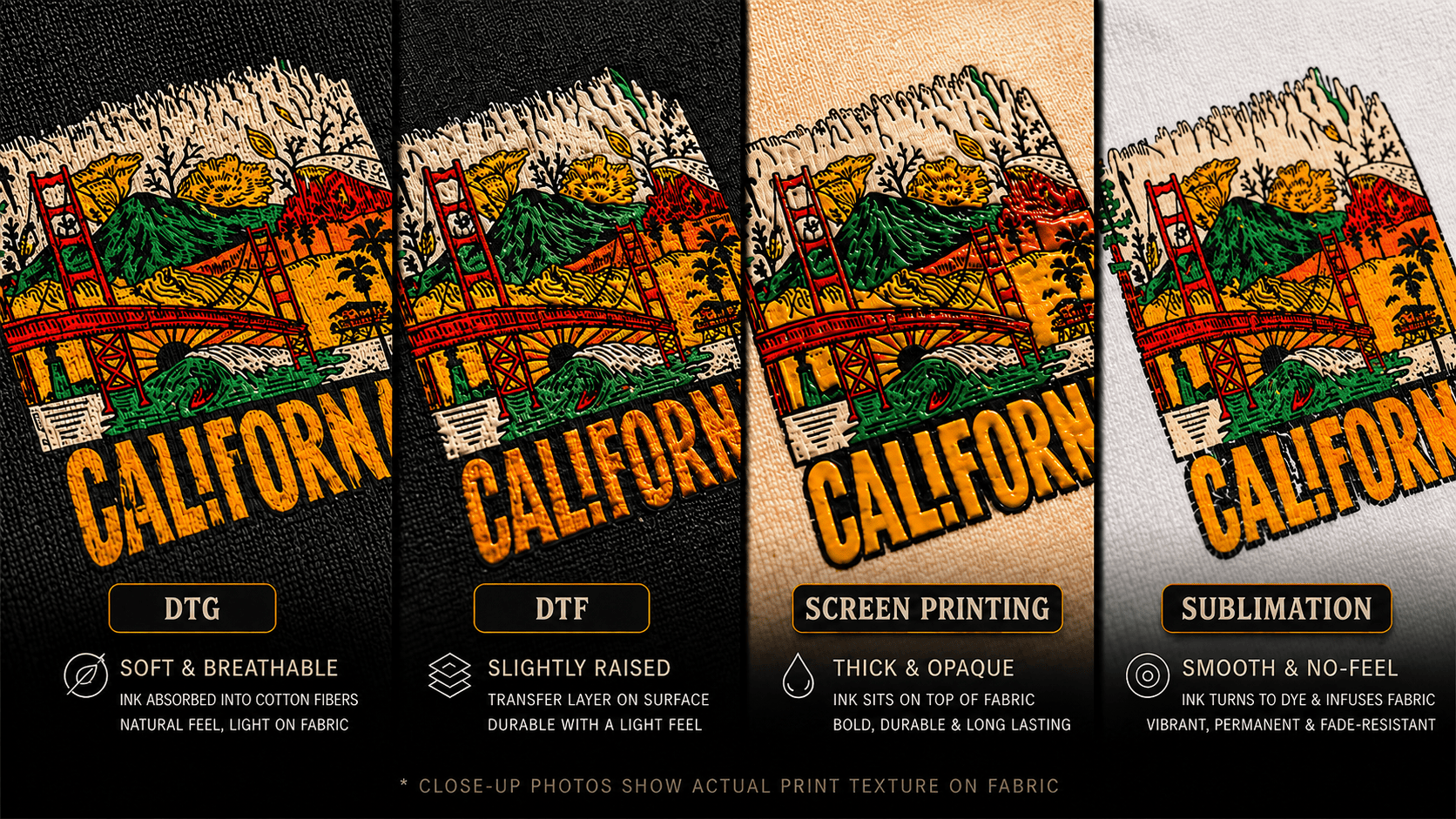
Which Printing Method Is Best for Each Fabric and Order Size?
When a customer asks us to help them decide, we tend to walk through it in the same order every time.
Start with the fabric. Pure cotton keeps every option open. Polyester rules out DTG and points you toward DTF or sublimation. Blends generally favor DTF. Then look at the garment color, because dark garments lean toward DTF, are workable but fussier with DTG, and are a non-starter for sublimation. Next, consider the artwork: photographs and gradients want DTG, bold two-to-four color designs suit almost anything, and very fine detail nudges you back toward DTG. After that, the quantity. Under 25 of one design, stay digital every time. Consistently over 50, it is worth running the screen printing numbers. Finally, think about how it should feel, from softest to heaviest: sublimation, then DTG, then DTF, then a heavy plastisol screen print.
For most catalogs this lands in the same comfortable place. Cotton tees go DTG, and hoodies, blends, activewear, and dark garments go DTF. Screen printing enters the picture once a design proves itself in volume, and sublimation covers the all-over and polyester work. If you are staring at a product and genuinely cannot tell which way to go, that is exactly the kind of thing worth a quick conversation before you commit a whole run to it.
Order a sample before you decide
None of this replaces holding the finished piece in your hands. Order your real design, on the exact garment and color you plan to sell, and then wash it a few times the way a customer actually would. Color shifts, cracking, and hand feel all tend to reveal themselves around the third or fourth wash, not on the day it arrives. It is a small cost that heads off the expensive version of the lesson, which usually shows up as a refund request and a two-star review.
Common questions
Which lasts longer, DTF or DTG?
DTF, as a rule. A well-cured DTF print holds up through more washes with less visible change, while DTG tends to soften and fade gradually. Both do better if customers wash cold and skip the dryer, which is worth a line on your product pages.
Can you print DTG on polyester?
You can, but you probably should not. The ink has little to bond to, so prints look dull and wear quickly, and dye from the fabric can migrate into the white ink over time. For polyester, use DTF.
Is screen printing higher quality than DTG or DTF?
It is more durable and more opaque, but whether it is better depends on the design. For a bold two-color graphic in volume, screen printing is hard to beat. For a photographic design, DTG will look considerably better than any screen print of the same image.
Why does my DTG print look washed out on a dark shirt?
Usually the pretreatment. Too little and the white underbase does not sit right, so the colors sink into the fabric. It can also be the blend, since DTG on a 50/50 will always look softer than on ring-spun cotton.
Can I use different methods across my store?
Yes, and most established sellers do. Cotton on DTG and everything else on DTF is the standard split. Customers never notice which method you used, only whether the print holds up.
Getting this right from the start is what separates the shops that field constant quality complaints from the ones that do not. It usually is not a secret supplier; it is matching the method to the garment before the product ever goes live, and sampling it properly before promoting it. If you would like a second opinion on which method suits a particular product, talk to us before you commit to a run. We are glad to walk through it with you, even when the honest answer points to a method we make less money on.
Which printing method is cheapest?
For one-off products and small orders, DTG or DTF is usually cheaper because neither requires screens or setup per color. For a larger run of the same design, screen printing often becomes cheaper per item once the setup cost is spread across enough pieces.
Which method is best for cotton, polyester, and blends?
DTG is strongest on 100% cotton and cotton-dominant garments. DTF works well on cotton, polyester, blends, and dark fabrics. Sublimation is best for light-colored polyester, while screen printing works across cotton and many blends when the ink system is matched to the garment.
Related guides
Switch to Pengine.
We offer a fully managed migration service at no extra cost, including product transfer and setup support.