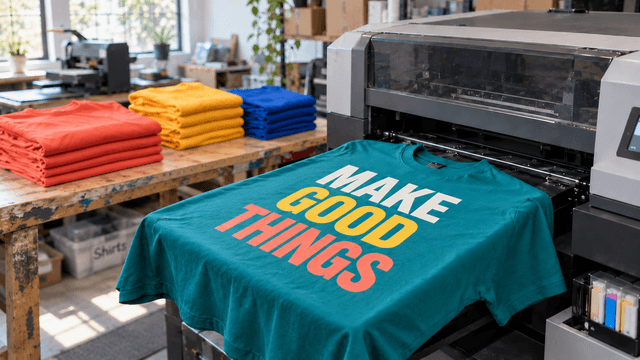
The Direct-to-Garment Printing Market in 2026: What the Numbers Actually Say
If you look up the size of the direct-to-garment printing market, you will get four different answers from four reputable research firms, and the largest is more than double the smallest. That is not a rounding problem — it is a sign that "the DTG market" means different things to different analysts. Here is what the numbers say, where they disagree, and what any of it means if you actually sell printed apparel.
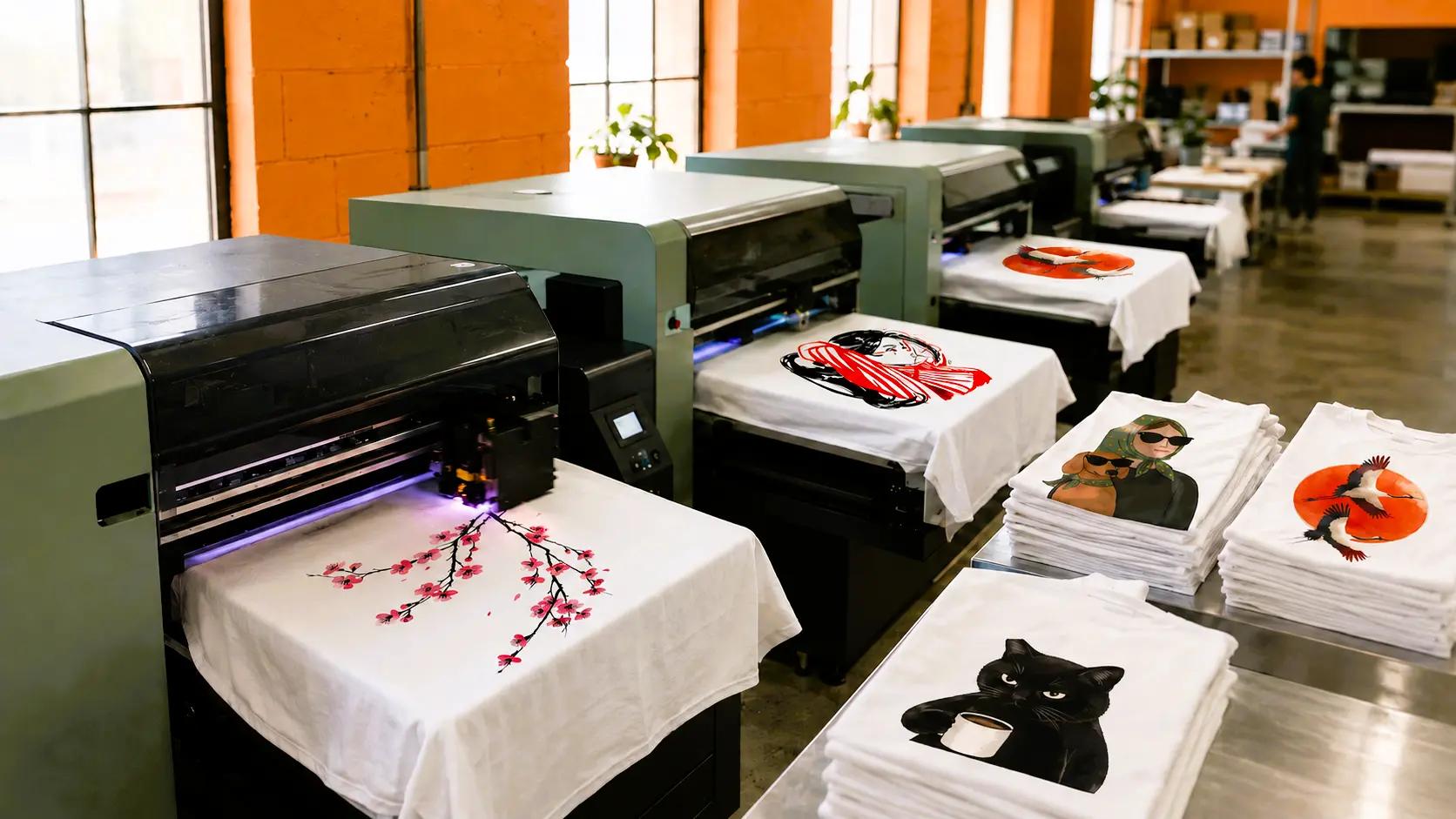
The short version
- Published estimates for 2025–26 range from $1.49 billion to $3.2 billion — a 2.1x spread for the same market in the same year.
- Forecast growth ranges from 7.1% to 14.1% CAGR, depending almost entirely on whether the analyst counts sublimation and home décor as "DTG."
- The only audited numbers tell a flatter story. Kornit Digital, the largest pure-play DTG equipment maker, grew total revenue 2.2% in 2025 and has guided Q1 2026 to roughly flat.
- But printing volume is growing much faster than the businesses selling the presses. Kornit's impressions rose 11% in 2025 against 2.2% revenue growth — existing machines are being run harder.
- DTF is already the bigger market. On Grand View Research's own like-for-like numbers, direct-to-film was worth $2.72 billion in 2024 against DTG's $2.1 billion in 2025.
- Print on demand is growing 2–4x faster than either. The selling layer ($10.8bn, 23.6% CAGR) is expanding far quicker than the printing layer beneath it.
| The four published forecasts | Market size | Forecast | CAGR | Region leader |
|---|---|---|---|---|
| Grand View Research | $2.1bn (2025) | $5.9bn by 2033 | 14.1% | Europe, 36.8% |
| Future Market Insights | $3.2bn (2025) | $9.1bn by 2035 | 11.0% | China fastest, 12.5% |
| Market Research Future | $1.49bn (2025) | $3.11bn by 2035 | 7.66% | North America, 36.4% |
| Mordor Intelligence | $1.49bn (2026) | $2.1bn by 2031 | 7.13% | North America, 39.1% |
How big is the direct-to-garment printing market?
Somewhere between $1.5 billion and $3.2 billion, and anyone who gives you a single confident figure is quoting one report and not mentioning the other three.
Grand View Research puts the market at $2.1 billion in 2025 (precisely, $2,117.2 million), reaching $5.9 billion by 2033 at a 14.1% CAGR. Future Market Insights is the most bullish on absolute size, at $3.2 billion in 2025 growing to $9.1 billion by 2035. Market Research Future and Mordor Intelligence land at the conservative end, both around $1.49 billion, with growth in the 7% range.
That is a genuine 2.1x disagreement on the base number and a 2x disagreement on the growth rate. For context, the four firms cannot even agree on which region is largest: two say North America (36.4% and 39.1%), one says Europe (36.8%). All four agree Asia-Pacific is growing fastest, which is about the only unanimous finding in the set.
Why do the estimates disagree by more than double?
Because "direct-to-garment printing" is not a standardised category, and the segment breakdowns give the game away.
Look at what each report counts as DTG ink. Grand View's report has sublimation at 52.1% of the market by ink type, and segments its applications into clothing, home décor, soft signage and industrial — with home décor expected to post the strongest growth. Mordor's has pigment inks at 60.45% and clothing at 57.2%.
Those are not the same market measured twice; they are two different markets wearing the same name. Sublimation is a dye-transfer process for polyester and hard goods — a neighbouring technology, not direct-to-garment — and soft signage and industrial output are not garments at all. On Grand View's own segmentation, more than half of its "DTG market" is not DTG as the trade uses the term. Fold all of that in and you get a bigger, faster-growing number. Keep the definition tight to pigment on garments and you land at $1.49 billion growing at around 7%, which is exactly where the two conservative reports sit.
Three other things move the number:
- Base year drift. Reports published across different years anchor to different bases, then compound forward. A 2024 base and a 2026 base produce different-looking headlines for the same underlying market.
- Scope of the value chain. Equipment only, or equipment plus ink, consumables, and print services? Ink and consumables are recurring revenue and considerably larger than printer sales.
- Forecast horizon. A 2035 endpoint flatters a market by giving compounding an extra five years to work. FMI's $9.1 billion is a 2035 number; Mordor's $2.1 billion is a 2031 number.
Worth knowing too that the reports are not always internally consistent. Grand View's headline 14.1% CAGR is a little ahead of what its own endpoints imply — $2,117.2 million in 2025 to $5,936.3 million in 2033 works out at about 13.8%. Small, but a reminder that these are models, not measurements.
None of this means the research is bad. It means the headline figure is close to meaningless without the definition attached, and almost nobody quoting these numbers online includes it.
What do the audited numbers say?
This is the part worth paying attention to, because it is the only part nobody estimated.
Kornit Digital is the largest publicly traded pure-play DTG equipment company, so its filings are an audited window into the same market the analysts are modelling. For full year 2025 it reported total revenue of $208.2 million, up 2.2% from $203.8 million in 2024, split between $156.1 million of products and $52.1 million of services. Fourth quarter revenue was $58.9 million, down from $60.7 million a year earlier. Its Q1 2026 guidance is $45–49 million against $46.5 million actually delivered in Q1 2025 — a midpoint that is essentially flat.
So the clearest real-world signal available shows low-single-digit growth, while the market models project 7% to 14%. Some of that gap is legitimate — one company is not a market, and Kornit sells into a specific industrial tier. But it is a meaningful check on the more excitable forecasts, and it is the number most blog posts on this topic leave out.
The detail that actually matters
Here is the figure that reframes everything above. Kornit reported that impressions across its installed base grew 11% in 2025 — CEO Ronen Samuel attributed it to "higher utilization across our installed base and increased adoption of digital production for longer runs."
Read those two numbers together. Total revenue up 2.2%. Actual printing volume up 11%.
The amount of DTG printing happening is growing roughly five times faster than the revenue of the industry's largest DTG supplier. Since ink and consumables scale with impressions rather than with machine sales, that gap implies press sales themselves were soft while the installed base worked harder. The industry is not buying many more machines; it is running the ones it already has much closer to capacity. That is what a maturing technology looks like, and it is the single most useful thing in this entire dataset — because a market that grows through utilisation rather than hardware sales behaves very differently for the people buying prints from it.
Is DTG losing ground to DTF?

Partly, and the honest answer is more interesting than a yes or no.
Comparing like with like — Grand View Research's own figures for both — direct-to-film was a $2.72 billion market in 2024, against DTG's $2.1 billion in 2025. DTF, the younger technology, is already the larger category. Europe leads both at roughly 36% share, and t-shirts dominate DTF's end-product mix.
The growth rates complicate the picture: the same firm models DTF at a 6.0% CAGR to 2030 and DTG at 14.1%. Take that with some salt, given everything above about definitions — but the plain reading is that DTF got big fast and is now normalising, while DTG's growth is being measured with a wider net.
What we see day to day is less dramatic than "one is killing the other." DTF handles polyester, blends, dark garments and awkward placements that DTG cannot; DTG still gives the softest hand feel and the best result on 100% cotton. Most serious print operations now run both and choose per job, which is exactly what the market data would predict for two technologies that solve overlapping but non-identical problems. Our DTG vs DTF vs screen printing comparison covers where each one wins on the shop floor.
Where is the growth actually happening?

Not in printing equipment. In selling.
Grand View Research values the print on demand market at $10.8 billion in 2025, reaching $57.5 billion by 2033 at a 23.6% CAGR — apparel is the largest slice at 39.5%, and North America leads with 36% of revenue. Set that against DTG's 7–14%:
| Market | 2025 size | CAGR |
|---|---|---|
| Print on demand | $10.8bn | 23.6% |
| DTG printing | $1.49–3.2bn | 7.1–14.1% |
| DTF printing | $2.72bn (2024) | 6.0% |
The layer where merchants operate is growing between two and four times faster than the layer where the printing happens. That is not a contradiction — it is the normal shape of a maturing supply technology underneath a fast-growing commercial model. The presses are a mature industrial market. What people do with them is not.
What does any of this mean if you sell printed apparel?
Four practical readings, which is the only reason a market report matters to a merchant at all.
Capacity is chasing your orders, not the other way round. Modest hardware growth plus an 11% rise in impressions means print operations are working to fill machines they have already paid for. Idle press time is expensive, which puts the negotiating position with a fulfillment partner in a better place than most sellers assume.
Method availability is now a real differentiator. With DTF and DTG both established and neither displacing the other, the useful question to ask a fulfillment partner is not "do you do DTG?" but "which method will you put my product on, and why?" A partner running one press has to answer every job with that press.
Don't read the equipment market as demand for your products. The 7–14% figures describe printer and ink sales. Consumer demand for customised apparel is tracked by the print on demand number, and that one is growing at 23.6%. Confusing the two is the most common mistake in this topic.
Asia-Pacific growth is a supply-side story. Every one of the four reports has APAC growing fastest, driven by digitalisation in China, India and Vietnam. For most sellers that shows up as more sourcing options and continued price pressure on blanks, not as a market to sell into.
If you are working out which method fits what you sell, the mechanics matter more than the market: here is what DTG printing is, what DTF printing is, and how print on demand works if you are earlier in the process.
Frequently asked questions
How big is the direct-to-garment printing market in 2026?
Published estimates range from about $1.5 billion to $3.2 billion. Mordor Intelligence puts it at $1.49 billion in 2026 and Market Research Future at $1.60 billion, while Grand View Research and Future Market Insights model $2.1–3.2 billion, largely because their definitions include sublimation and non-apparel applications.
What is the growth rate of the DTG printing market?
Forecast CAGRs run from 7.13% (Mordor Intelligence, to 2031) to 14.1% (Grand View Research, to 2033). The audited results of the largest pure-play DTG equipment maker showed 2.2% revenue growth in 2025, which suggests the conservative end is closer to current reality for hardware.
Is DTG printing still growing?
Yes, but in volume more than in equipment spend. Kornit Digital reported 11% growth in impressions across its installed base in 2025 against 2.2% total revenue growth — more printing on roughly the same number of machines.
Is the DTF market bigger than the DTG market?
On Grand View Research's like-for-like figures, yes: DTF was $2.72 billion in 2024 against DTG's $2.1 billion in 2025. DTF grew very quickly from a standing start and now sits alongside DTG rather than replacing it.
Which region leads the DTG printing market?
The reports disagree — Mordor Intelligence (39.1%) and Market Research Future (36.4%) put North America first, while Grand View Research gives Europe 36.8%. All four agree Asia-Pacific is the fastest-growing region.
Why do DTG market size estimates vary so much?
Because the category is defined differently by each firm. Some count sublimation inks and home décor applications, which roughly doubles the number; others limit it to pigment inks on garments. Base years, forecast horizons, and whether ink and print services are included on top of equipment account for most of the rest.
The bottom line
The direct-to-garment printing market is somewhere between $1.5 billion and $3.2 billion, growing at somewhere between 7% and 14%, and the honest version of that sentence is the range rather than any single number inside it. The more useful finding is buried underneath: printing volume is growing roughly five times faster than printing hardware, DTF has become a peer technology rather than a successor, and the commercial layer on top of both is growing several times faster than either.
For anyone selling printed apparel, that adds up to something fairly reassuring. There is more capacity than there is competition for it, and the choice that affects your product is not which market is bigger but which method ends up on your garment. If you are weighing that up, talk to us before you commit to a blank or a method — we print these every day, and it is a much cheaper conversation to have before the order than after the return.
Where these numbers come from
Figures are taken from the published report pages of Grand View Research (direct-to-garment, direct-to-film and print-on-demand), Mordor Intelligence, Future Market Insights and Market Research Future, together with Kornit Digital's Q1 2025 and full-year 2025 results releases, all accessed 31 August 2026. Research firms revise these reports and change their base years, so a figure quoted elsewhere with a different horizon is not necessarily wrong — check which edition it came from.
Related guides

Switch to Pengine.
We offer a fully managed migration service at no extra cost, including product transfer and setup support.